Along the Bellarine Peninsula, the sandy coastal soils around Geelong differ sharply from the stiff clays found inland near Waurn Ponds. For a developer planning a 15-unit townhouse complex in Newcomb, the shallow water table and loose sand layers made conventional shallow footings unworkable. That is where vibrocompaction design came in — a proven method to densify granular soils in place using deep vibratory probes. Before mobilising the rig, the geotechnical team ran a georadar survey to map buried services and a dilatometer test to measure lateral stress profiles across the site. The result was a cost-efficient ground improvement plan that eliminated the need for piles.
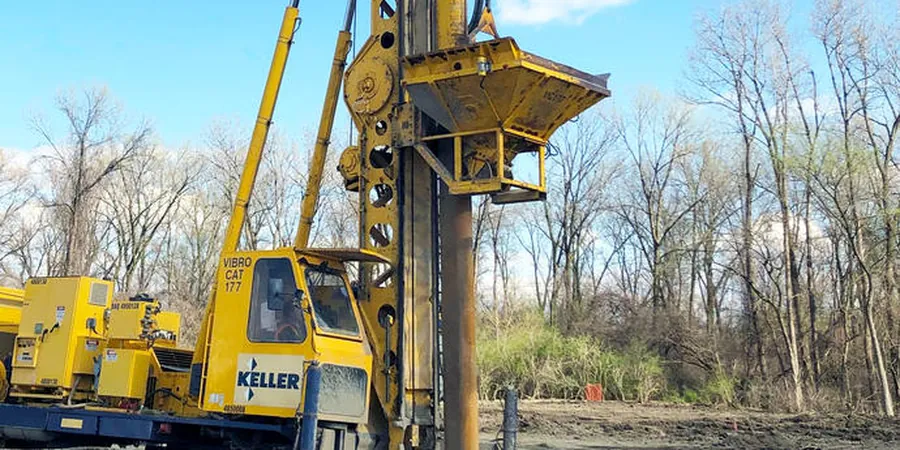
Vibrocompaction in Geelong's coastal sands can reduce liquefaction potential by 40 to 60 percent when designed to a target relative density of 75 percent.
Scope of work in Geelong
- Pre-treatment CPT to establish baseline density and fines content.
- Field trial at a test cell to verify depth of influence and settlement reduction.
- Post-treatment verification using CPT and plate load tests.
Typical technical challenges in Geelong
The Quaternary sands underlying much of Geelong's coastal strip have low SPT blow counts — often 4 to 8 blows per 300 mm — making them prone to liquefaction under seismic loading. According to AS/NZS 1170.4:2007, Geelong falls into a moderate seismicity zone (hazard factor Z = 0.08), so loose saturated sand layers can experience excess pore pressure during an earthquake. Without proper vibrocompaction design, a 1-in-500-year event could trigger differential settlements exceeding 150 mm beneath lightly loaded structures. A recent study on the Corio Bay shoreline found that untreated sand with relative density below 50 percent had a liquefaction probability of 65 percent, a risk that drops sharply after densification to 75 percent.
Our services
Our geotechnical team provides the full spectrum of vibrocompaction design services in Geelong, from desktop feasibility studies through to post-treatment verification.
Feasibility & Soil Screening
A targeted desktop review of existing borehole logs and geological maps (e.g., Geological Survey of Victoria 1:50,000) to determine whether vibrocompaction is economically viable for your Geelong site. Includes preliminary liquefaction triggering analysis.
Detailed Design & Field Trial Supervision
Full design report specifying probe pattern, depth, energy, and backfill material. Our engineers supervise the field trial at a representative area of your site, adjusting parameters based on real-time CPT readings.
Post-Treatment Verification & QA/QC
Independent verification using CPT, SPT, and plate load tests to confirm that the treated ground meets the specified relative density and settlement criteria. A certified report is issued for your structural engineer and building surveyor.
Frequently asked questions
What types of soil respond best to vibrocompaction in Geelong?
Clean, cohesionless sands with less than 15% fines (passing the #200 sieve) are ideal. In Geelong, the coastal dune sands around Moolap and Newcomb typically meet this criterion, whereas the clayey sands of the Moorabool River valley may require alternative methods like deep soil mixing.
How much does vibrocompaction design cost in Geelong?
A full design package — including site visit, soil model, trial supervision, and verification testing — typically ranges between AU$1,950 and AU$8,530 depending on site size and complexity. For a standard 2,000 m² residential lot, expect around AU$4,200.
Can vibrocompaction reduce liquefaction risk under existing buildings?
No — vibrocompaction requires direct access to the ground surface for the vibratory probe. For existing structures in Geelong, consider alternative ground improvement such as jet grouting or compaction grouting from the side. A structural assessment is always needed first.
What verification testing is required after vibrocompaction?
We recommend a minimum of one CPT per 500 m² of treated area, plus one plate load test per soil type. For Geelong projects near the waterfront, we also run shear wave velocity measurements to confirm the in-situ stiffness increase. All results are compared against the design target relative density.