A tracked excavator fitted with a 600-mm bucket begins the first test pit at a proposed industrial-access road on the Bellarine Peninsula. The operator stops at 1.8 m where a perched water table appears within the estuarine silt. Our field team immediately installs a standpipe piezometer to record the phreatic level over a 48-hour window. This real-time pressure data feeds directly into the drainage model we build for the pavement subgrade. In Geelong, where seasonal rainfall exceeds 500 mm annually and the Barwon River floodplain creates variable saturation zones, designing an effective geotechnical road drainage system demands site-specific hydraulic conductivity values. We combine falling-head tests in the test pit with laboratory permeameter checks on undisturbed samples to confirm the coefficient of permeability before specifying pipe spacing or gravel blanket thickness.
In Geelong, perched water tables in estuarine silts can reduce subgrade CBR by over 60 % if road drainage is not designed from the first test pit.
Scope of work in Geelong
Key parameters we assess for Geelong projects:
- In-situ permeability via falling-head tests in boreholes (AS 1289).
- Particle-size distribution to design graded filter layers — also used for granulometria analysis.
- Groundwater fluctuation monitoring across wet-dry seasons.
Typical technical challenges in Geelong
Geelong expanded rapidly from the 1960s with residential estates built on former wetlands and floodplain terraces. Many existing roads now show longitudinal cracking and edge subsidence caused by water trapped beneath the pavement structure. The historical practice of placing fill directly on saturated clay without engineered drainage has left a legacy of differential settlement. Inadequate geotechnical road drainage accelerates base-course degradation, especially in areas like Waurn Ponds and North Geelong where the water table sits within 1.5 m of the surface. Retrofitting a drainage system after pavement failure costs three to five times more than including it at the design stage. The geotechnical road drainage design must account for the seasonal rise of the water table and the low permeability of the underlying Newer Volcanic basaltic clay.
Our services
We deliver integrated geotechnical road drainage services across Geelong, from concept design through construction supervision.
Subsurface drainage design
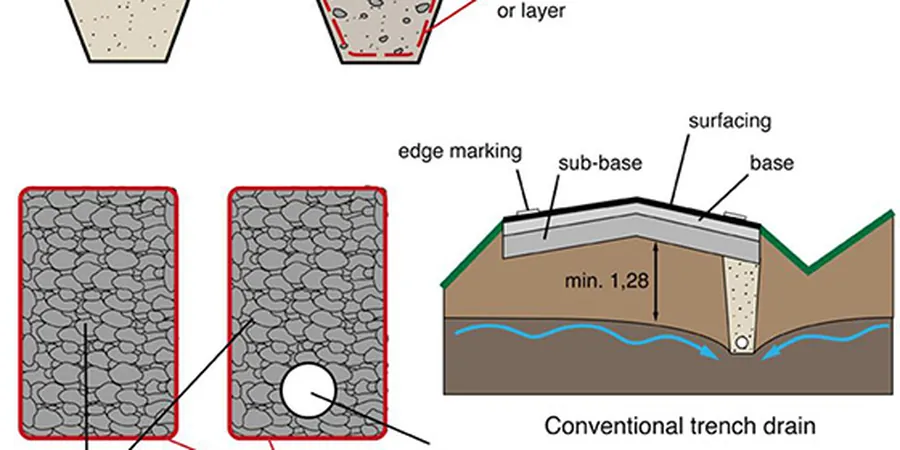
Pipe networks, fin-drains, and gravel blankets sized using Darcy's law and site-measured k-values. We specify cleanout points and outlet locations to prevent blockages in Geelong's clay-rich soils.
Groundwater monitoring and modeling
Installation of vibrating-wire piezometers and standpipes with automated dataloggers. Monitoring over a full wet season to capture peak phreatic levels for drainage design.
Subgrade improvement and filtration
Graded granular filters and geotextile separation layers to prevent pumping of fines into the drainage aggregate. We verify compatibility with the existing subgrade soil.
Frequently asked questions
What causes road drainage failure in Geelong soils?
The main cause is a perched water table sitting above a low-permeability clay layer. Without a properly designed geotechnical road drainage system, water accumulates in the pavement subgrade, reducing bearing capacity and leading to rutting and cracking. Geelong's estuarine silts and basaltic clays are particularly prone to this behaviour.
How much does a geotechnical road drainage study cost in Geelong?
For a typical residential street or industrial access road, the cost ranges between AU$1.220 and AU$4.250 depending on the number of test pits, laboratory tests, and the complexity of the drainage model. A detailed quote is prepared after reviewing the site layout and soil conditions.
What field tests are used to design road drainage?
We perform falling-head permeability tests in test pits or boreholes, install piezometers to measure the water table level, and collect undisturbed samples for laboratory hydraulic conductivity tests. Grain-size analysis helps design filter layers that prevent clogging. These tests follow AS 1726 and AS 1289.
Can drainage be retrofitted under an existing Geelong road?
Yes, but it is more expensive and disruptive. We use trenchless techniques like directional drilling for pipe installation or install edge drains along the shoulder. The design must account for the existing pavement structure and traffic loads during construction. A site investigation is always required first.