In Geelong, we often see retaining walls that fail not because the materials are poor, but because the designer did not account for the high plasticity clays that dominate the Newer Volcanic basalt-derived soils across the Bellarine Peninsula. A proper retaining wall design must start with a site-specific geotechnical investigation – drilling test pits or boreholes to classify the soil profile, measure undrained shear strength, and identify the groundwater regime. Without this data, the applied lateral earth pressure assumptions are guesses, not engineering. For example, expansive clays can exert significantly higher pressures than standard Rankine or Coulomb theory predicts, especially if the backfill becomes saturated after heavy rain. We combine field data with limit–state design per AS 4678 to ensure the wall resists both static and seismic loads typical of the region's moderate seismicity.
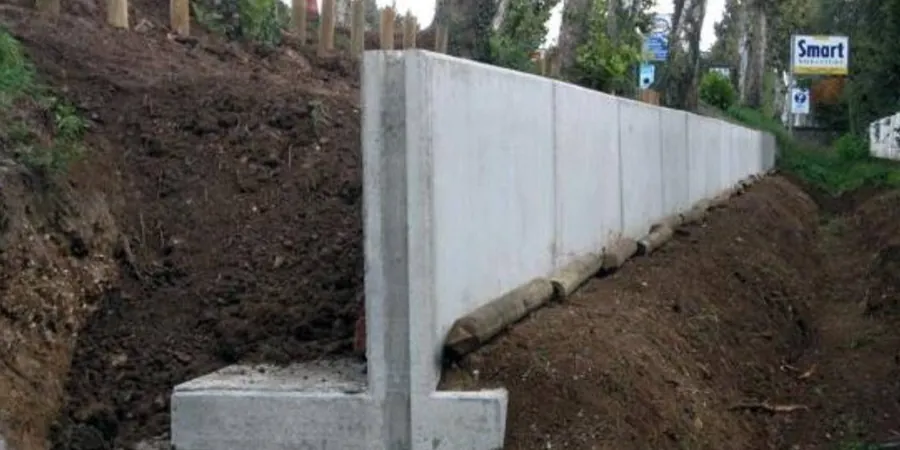
A retaining wall design without site-specific soil data is not engineering – it is a gamble with lateral earth pressures.
Scope of work in Geelong
Typical technical challenges in Geelong
The coastal climate in Geelong – with cool, wet winters and dry summers – creates a cyclic wetting‑drying pattern that can destabilise the backfill behind a retaining wall if not properly drained. The risk is amplified in the low‑lying areas near Corio Bay where the water table is shallow, and in the clay‑rich soils of the northern suburbs where shrink‑swell behaviour can crack the wall or tilt it forward over time. A retaining wall design that ignores these seasonal moisture changes will likely experience progressive lateral movement, cracked panels, or even complete collapse after several years of service. We address this by incorporating a free‑draining granular backfill zone, a perforated drainage pipe at the base, and a waterproof membrane on the wall face to protect the structural concrete from chloride attack from the marine environment.
Our services
We offer three complementary services that support a reliable retaining wall design in Geelong.
Geotechnical Investigation & Soil Testing
Boreholes, test pits, and laboratory testing to determine shear strength, unit weight, and consolidation properties of the foundation and backfill soils.
Structural Retaining Wall Design
Limit‑state design of cantilevered, gravity, or reinforced concrete walls per AS 4678, including stability checks for overturning, sliding, and bearing capacity.
Drainage & Waterproofing Solutions
Design of drainage blankets, geotextile filters, and waterproof membranes to control groundwater and prevent hydrostatic pressure buildup behind the wall.
Frequently asked questions
What is the typical cost range for a retaining wall design in Geelong?
The cost of a full retaining wall design package – including geotechnical investigation, structural analysis, and drawings – typically falls between AU$1,520 and AU$7,430, depending on wall height, soil complexity, and site access conditions.
Do I need a geotechnical investigation for a retaining wall shorter than 1.5 m?
For walls under 1.5 m on stable, well‑draining sand or gravel, a simplified design may be acceptable. However, Geelong's variable geology – from soft marine clays to stiff basalt – means a test pit or soil classification is still strongly recommended to confirm bearing capacity and avoid unexpected lateral movement.
What is the difference between a cantilever and a gravity retaining wall?
A cantilever wall uses a reinforced concrete stem and base slab to resist overturning through its own weight and the soil on the heel. A gravity wall relies solely on its mass – often using concrete, stone, or gabions – to resist sliding and overturning. The choice depends on wall height, available space, and soil conditions.
How does the design address seismic loads in Geelong?
Geelong is in a moderate seismic zone per AS 1170.4. The design includes a horizontal seismic coefficient that increases the active earth pressure on the wall. We also check for potential liquefaction in loose saturated sands and evaluate global stability under earthquake loading.