In Geelong, many projects cut into the Newer Volcanics basalt or the Quaternary alluvium along the Barwon River. A standard SPT in basalt gives a blow count that is hard to convert to a useful modulus. That is where the Ménard pressuremeter test (PMT) comes in. It measures the soil or rock in situ under controlled radial expansion. We get the Ménard modulus (EM) and the limit pressure (pL) directly. These two numbers feed into bearing capacity and settlement calculations without relying on empirical correlations. For deep foundations, the PMT is the reference method in the French pressuremeter rules (NF P94-110) and is increasingly adopted in Australian practice, especially in Geelong’s mixed geology.
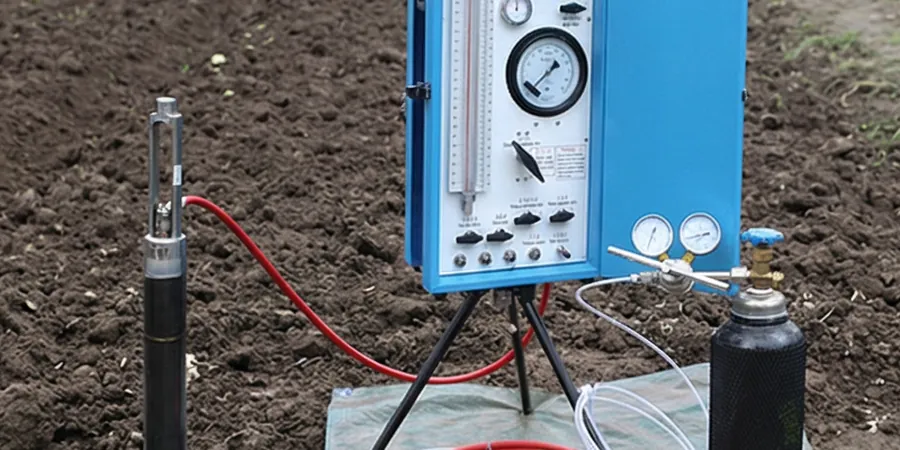
The PMT gives EM and pL directly—no correlations, no guesswork. In jointed basalt it is the only reliable way to size a pile.
Scope of work in Geelong
Typical technical challenges in Geelong
The main risk in Geelong is assuming basalt behaves like a homogeneous rock. Joints and vesicular zones cause localised weakness that a SPT or point load test can miss. In the Belmont and Highton suburbs, the basalt cap is often only 2–4 m thick, underlain by soft clay or sand. A pile socketed into basalt may actually bear on weathered rock with an EM one order of magnitude lower. The PMT detects these weak zones by giving a continuous profile of modulus and limit pressure. Without it, the foundation design is based on assumptions that may not hold.
Our services
We offer two complementary PMT-based services that cover the typical needs of Geelong projects.
PMT for shallow foundations
We run PMTs at multiple depths within the foundation zone to obtain EM and pL for each stratum. The results feed directly into elastic settlement and bearing capacity calculations for footings on basalt, stiff clay, or cemented sand.
PMT for pile design
For bored piles in Geelong, we perform PMTs at pile toe depth and at 1 m intervals along the shaft. The limit pressure profile defines the end-bearing and side-friction parameters according to the pressuremeter method (Frank & Zhao).
Frequently asked questions
How does the Ménard pressuremeter test differ from a standard SPT?
The SPT measures a dynamic blow count that correlates to relative density or consistency. The PMT measures a stress-strain curve under controlled radial expansion, giving the Ménard modulus (EM) and limit pressure (pL) that are direct inputs for settlement and bearing capacity calculations. In Geelong’s basalt, the PMT captures the real deformability of joints and vesicles, which the SPT cannot.
What is the typical cost range for a PMT in Geelong?
The cost for a Ménard pressuremeter test in Geelong is between AU$1,770 and AU$2,120 per test depth, including drilling, probe, and field report. The total depends on access, number of tests, and whether casing is required in collapsing ground. Contact us for a project-specific quote.
In which ground conditions is the PMT most useful in Geelong?
The PMT is most valuable in the Newer Volcanics basalt (jointed, vesicular) and in the Quaternary alluvium (loose sand, soft clay) along the Barwon River. In stiff clay of the Pliocene Moorabool Viaduct formation, the PMT gives a reliable modulus for raft foundation design. It is less useful in clean gravel or bouldery ground where the probe cannot expand uniformly.
How long does a PMT campaign typically take for a residential site?
For a standard residential lot in Geelong, we usually run 3 to 5 PMTs at different depths in one borehole. The field work takes half a day including drilling, probe calibration, and testing. The laboratory analysis and report are delivered within three working days. The total turnaround is faster than a full triaxial suite.