The Barwon River and Corio Bay shape Geelong's subsurface more than most people realize. We see it in nearly every project near the waterfront or along the Moorabool River floodplain: layers of soft clay, loose silty sand, and occasional gravel lenses that make traditional deep foundations unpredictable. Jet grouting design in Geelong addresses this variability head-on by creating engineered soil-cement columns that can reach 15 m depth or more. The coastal humidity and shallow water table mean every injection program must account for groundwater chemistry and flow rates, which is why we always pair the design phase with a detailed permeability field test to calibrate grout take and column diameter before mobilising production rigs.
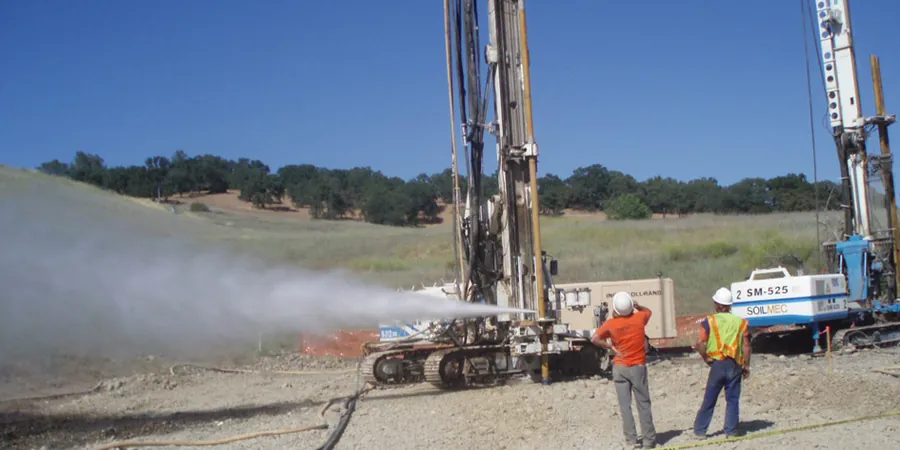
Jet grouting design in Geelong must account for variable groundwater flow rates and alluvial layering to achieve consistent column diameters and strength.
Scope of work in Geelong
Typical technical challenges in Geelong
The main geological hazard around Geelong is the presence of loose to very loose silty sands with occasional peat lenses, especially between Newtown and South Geelong. These materials can collapse under injection pressure if the grout parameters are not adjusted, leading to ground heave or column necking. We also encounter acid sulfate soils along the coastal fringe, which attack untreated grout and reduce long-term strength. Our jet grouting design in Geelong always includes a trial column program with coring and UCS testing before full production; that step alone has saved clients from expensive rework on at least three projects in the past two years. Without proper design, the risk of differential settlement between treated and untreated zones remains high.
Our services
We offer two complementary design packages for jet grouting in Geelong, each adapted to local ground conditions and project scale.
Single-fluid jet grouting design
Uses cement grout injected at 40–60 MPa through a single nozzle. Suitable for cohesive soils and shallow columns up to 10 m depth. Typical column diameters of 0.8–1.5 m. Includes trial column layout, grout mix design, and QA/QC protocol per AS 1726.
Double-fluid and triple-fluid jet grouting design
Adds compressed air shroud (double) or air + water jet (triple) to cut larger columns, up to 3.5 m in sandy soils. Used for deep cutoffs, bottom sealing, and liquefaction mitigation on sites like the Geelong Ring Road or waterfront developments. Full instrumentation plan with flow, pressure, and return density logging.
Frequently asked questions
What is the typical cost range for jet grouting design in Geelong?
For a medium-complexity project on the Bellarine Peninsula or Geelong CBD, design fees including trial column and mix design are between AU$2,730 and AU$10,380. The final figure depends on depth, number of columns, and whether laboratory testing on site soils is required.
How long does a jet grouting design take before production can start?
A standard design package takes 3 to 5 weeks from receipt of geotechnical data. This includes parameter selection, trial column layout, and a 7‑day curing period for test columns before UCS verification. For urgent projects we can compress the timeline to 2 weeks using accelerated curing.
Can jet grouting design mitigate liquefaction risk in Geelong's sandy soils?
Yes. In loose saturated sands typical of the Barwon River floodplain, jet grouted columns act as both ground reinforcement and drainage elements. The design must target a column spacing that ensures overlapping treatment zones, typically 1.2 to 2.0 m centre-to-centre, to achieve a post-treatment SPT blow count above 30. We always cross-check against Youd-Idriss (2001) liquefaction triggers.