Geelong sits on a complex mix of Quaternary alluvium and Tertiary basaltic clays. These soils are highly reactive, meaning they swell when wet and shrink when dry. The region's Mediterranean climate, with wet winters and dry summers, creates constant moisture cycles. This drives ground movement that can crack slabs, tilt footings, and distort pavements. Expansive soil evaluation in Geelong starts with identifying the clay mineralogy. Smectite clays dominate here, giving shrink-swell indices often exceeding 5%. Without proper testing, foundations on these soils risk differential movement exceeding structural tolerances. We use oedometer and free-swell tests to quantify volume change potential. Combining this data with local rainfall records helps predict seasonal movement amplitude. For deep profiles, we integrate consolidation readings to separate immediate elastic from time-dependent creep. It is a systematic process that prevents costly repairs.
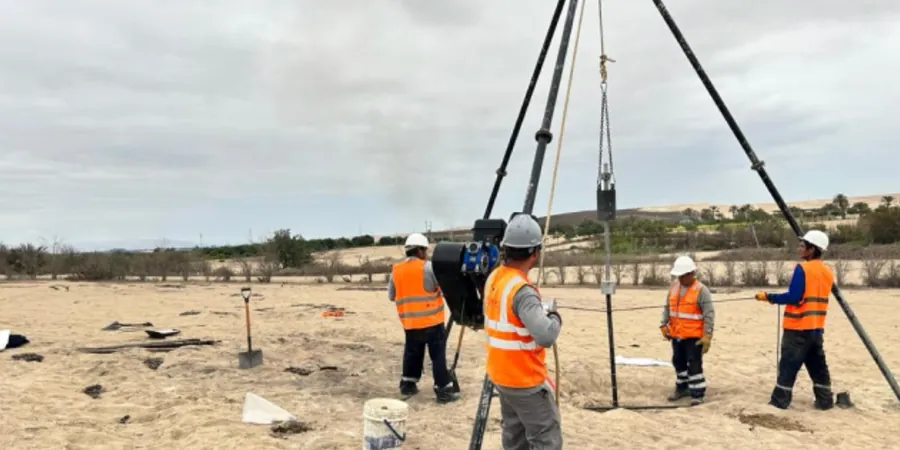
On reactive basaltic clays in Geelong, shrink-swell indices often exceed 5% — movement that can crack slabs within two years if unaddressed.
Scope of work in Geelong
Typical technical challenges in Geelong
Geelong's population has grown past 280,000, pushing new housing onto marginal land with deep reactive clays. The risk is not just swelling — it is the differential movement between wet zones near gardens and dry zones under eaves. In subdivisions around Armstrong Creek and Waurn Ponds, we have recorded up to 70 mm of seasonal slab heave in poorly prepared sites. Expansive soil evaluation in Geelong catches this early. Ignoring it leads to cracked brickwork, jammed doors, and foundation remediation costs that dwarf the initial test price. The local clay profile changes fast over 20 m, so test pit locations matter. We place them where moisture variation is highest.
Our services
We offer targeted services for expansive soil evaluation in Geelong. Each one addresses a specific stage of the assessment process.
Reactive Clay Profiling
Borehole or test pit sampling at 0.5 m increments down to 3.0 m. We log moisture content, plasticity, and shrink-swell behavior per depth.
Shrinkage Index Testing
NATA-accredited linear shrinkage and free-swell tests. Data feeds directly into AS 2870 site classification and Ys calculation.
Moisture Monitoring
Installation of neutron probes or TDR sensors to track seasonal moisture changes. Useful for post-construction verification of slab performance.
Foundation Movement Assessment
Crack mapping, level surveys, and soil suction profiling. We correlate observed damage with soil reactivity to recommend remedial footing design.
Frequently asked questions
What is the cost of an expansive soil evaluation in Geelong?
A standard evaluation for a residential lot ranges between AU$1,000 and AU$2,830 depending on depth, number of test pits, and laboratory testing scope. This includes sampling, Atterberg limits, linear shrinkage, and a site classification report per AS 2870.
How deep do you need to sample for reactive clays in Geelong?
We typically sample to 3.0 m depth, as the active zone in Geelong clays extends 1.5–2.5 m. Deeper sampling is needed near trees or where fill is present. The goal is to capture the full moisture variation profile.
Can expansive soil evaluation be done after the slab is poured?
Yes, but it is less conclusive. We use core drilling through the slab to retrieve subgrade samples. Cracking patterns and moisture profiles help infer soil reactivity, but the best data comes from pre-construction testing.