Geelong sits on a mix of Quaternary alluvium, estuarine clays, and basalt bedrock. The soft Barwon River floodplain soils are particularly prone to long-term settlement under load. That is why an oedometer consolidation test becomes essential before designing foundations, embankments, or pavement layers. The test measures how much and how fast a saturated clay layer will compress under vertical stress. We apply incremental loads to undisturbed samples and record deformation over time. The results give us the compression index (Cc), recompression index (Cr), and coefficient of consolidation (Cv). These parameters directly feed into settlement calculations for structures in Geelong. Without reliable consolidation data, you risk differential settlement that cracks slabs and misaligns services. The test follows AS 1289.6.6.1, ensuring results are accepted by local certifiers and engineers. For deeper foundation designs, we often pair this test with a pile load test to verify bearing capacity in the underlying basalt.
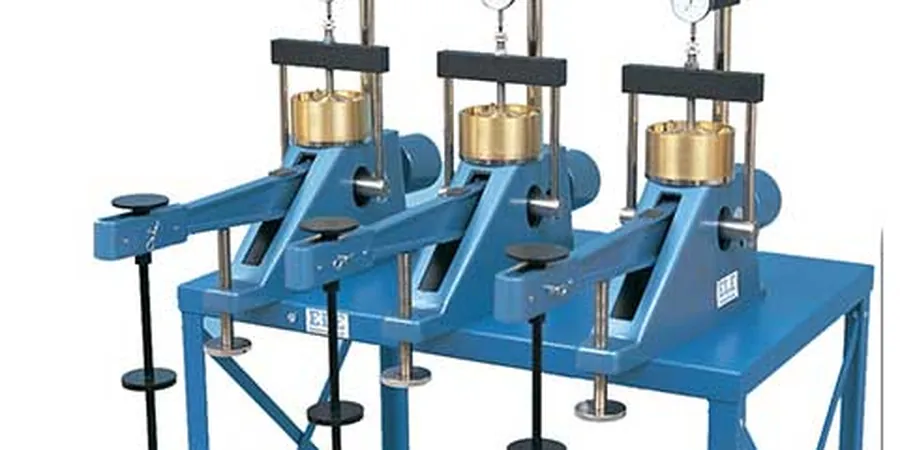
In Geelong's soft estuarine clays, the oedometer test separates a safe slab from one that cracks within the first year.
Scope of work in Geelong
- Trimming undisturbed thin-walled tube samples to 50 mm diameter.
- Applying a sequence of vertical stresses from 12.5 kPa up to 3200 kPa, depending on the expected service load.
- Recording dial readings at logarithmically spaced time intervals for each load increment.
- Plotting e-log p curves to determine pre-consolidation pressure and compression indices.
Typical technical challenges in Geelong
Geelong sits at an elevation of only 14 metres above sea level near Corio Bay. Much of the flat land along the Barwon River consists of soft alluvial clays less than 10 metres thick. These soils have high void ratios and low pre-consolidation pressures, meaning they are still undergoing natural consolidation. If you place a heavy embankment or a multi-storey building without an oedometer consolidation test, the long-term settlement can exceed 200 mm over a decade. That kind of movement damages underground utilities, breaks pavement joints, and causes structural distress. The risk is highest in suburbs like South Geelong and Newcomb, where the water table is close to the surface. Ignoring consolidation behaviour in these areas is a common cause of costly remedial work. Our test data helps you design ground improvement or deep foundations that match the actual settlement profile of the site.
Our services
We offer a full suite of consolidation testing services tailored to Geelong's soil conditions.
Standard Incremental Oedometer Test
The classic multi-step load test with full e-log p curve and Cv determination. Suitable for most building and road projects on soft clay.
Constant Rate of Strain (CRS) Test
A faster alternative that applies a constant deformation rate. Useful for preliminary design when time is limited.
Swelling Pressure Test
Measures the pressure that an expansive clay exerts when wetted. Essential for reactive soils in the Bellarine Peninsula.
Coefficient of Consolidation (Cv) Profile
Detailed Cv determination at multiple stress increments. Helps predict the rate of settlement for staged construction sequencing.
Frequently asked questions
How much does an oedometer consolidation test cost in Geelong?
The typical cost ranges between AU$300 and AU$690 per test point, depending on the number of load increments and whether swelling pressure is included. Bulk testing for a large subdivision may reduce the per-point rate.
What is the difference between the compression index (Cc) and the recompression index (Cr)?
Cc describes the slope of the virgin compression line on an e-log p plot. It tells you how much a normally consolidated clay will compress under new load. Cr describes the slope of the unloading-reloading loop. It applies when the soil has already been loaded in the past, such as under an existing fill or previous structure.
When should I request an oedometer test instead of a simple Atterberg limits test?
Atterberg limits tell you the plasticity of a clay, but they do not measure how it will compress under load. You need an oedometer test whenever settlement is a design concern. This includes projects with heavy structural loads, embankments, raft foundations, or pavement subgrades on soft alluvial soils like those found in Geelong's floodplains.