The contrast between Geelong's northern suburbs, where basalt-derived clays dominate, and the coastal sands of the Bellarine Peninsula creates distinct challenges for subsurface water management. A geotechnical drainage design in Geelong must address the low permeability of the Corio clay extending inland from the bay, while also handling the perched water tables common in the Newtown and Highton areas. Before specifying any system, the team typically runs a permeability field test to measure in-situ hydraulic conductivity, then correlates results with the local geology to size collector drains and sumps. The city's annual rainfall of around 520 mm, concentrated in winter, demands that drainage systems handle peak flows without saturating the subgrade.
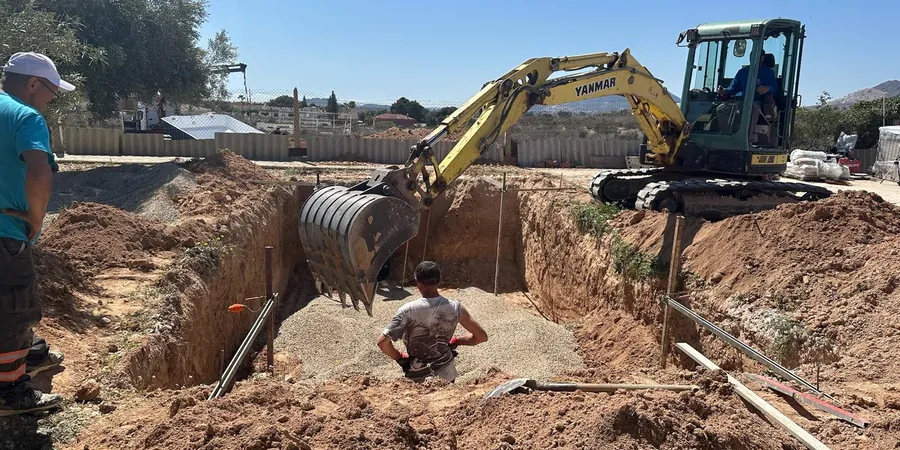
Geelong's basaltic clay layers produce hydraulic conductivity values below 10⁻⁶ m/s, making interceptor drains and gravel blankets essential for subsurface water control.
Scope of work in Geelong
- Hydraulic conductivity (k) from falling-head tests
- Design storm return period (typically 20-year ARI for residential lots)
- Filter compatibility criteria between soil and aggregate
- Slope stability checks for cut slopes exceeding 3 m height
- Discharge capacity to council-approved stormwater networks
Typical technical challenges in Geelong
AS 4678:2002 on earth-retaining structures and AS 1726:2017 on geotechnical site investigations both apply directly to drainage design in Geelong. The city's position on the Otway Basin, with variable groundwater levels influenced by irrigation cycles in the surrounding farmland, means that ignoring seasonal water table fluctuations can lead to hydrostatic pressure behind retaining walls or failure of shallow foundations. A thorough drainage design in Geelong must verify that the discharge point has adequate capacity and that the system does not redirect water onto neighbouring properties, a common source of disputes in the region.
Our services
Our drainage design service in Geelong covers four specialised areas to manage subsurface water across different site conditions.
Slope Drainage and Cut-off Trenches
Interceptor drains placed upslope of cuts and fills to prevent water ingress into the subgrade, designed with filter geotextiles and gravel to maintain long-term performance in clay soils.
Foundation Drainage for Retaining Walls
Perforated pipe systems with cleanout risers placed behind walls to relieve hydrostatic pressure, sized according to the retained height and soil permeability.
Surface Water Management for Residential Lots
Integration of swales, sumps, and subsoil drains to manage runoff from roofs and paved areas, compliant with City of Greater Geelong stormwater bylaws.
Groundwater Control for Basement Excavations
Temporary dewatering schemes using wellpoints or sump pumps, with settlement monitoring of adjacent structures during the drawdown phase.
Frequently asked questions
What is the typical cost range for a geotechnical drainage design in Geelong?
For a standard residential lot with one retaining wall and interceptor drains, the design fee ranges between AU$1,350 and AU$3,350 depending on site complexity and the number of boreholes required.
How deep should interceptor drains be placed in Geelong's clay soils?
Interceptor drains are typically installed at a depth of 1.2 to 1.8 m, extending at least 300 mm below the base of the cut slope to capture seepage before it reaches the exposed face.
Do I need a geotechnical drainage design for a small retaining wall under 1 m?
Even walls under 1 m can suffer from hydrostatic pressure if the backfill is clay and no drainage is provided. A simple design with a perforated pipe and gravel blanket is recommended to prevent long-term movement.
What stormwater discharge standards apply in Geelong?
The City of Greater Geelong requires that all drainage systems discharge to an approved point, typically the kerb and channel or a council-approved drainage easement, with a maximum flow rate per the local drainage code.
Can drainage design help with soil expansion in Geelong's clays?
Yes. Proper drainage reduces moisture variation in the active zone, which in turn minimises cyclic swelling and shrinkage of the basaltic clay, protecting footings and slab-on-ground from differential movement.