The contrast between the stiff Quaternary basalts of the Bellarine Peninsula and the soft alluvial clays of the Barwon River corridor in central Geelong illustrates why deep soil mixing (DSM) design must be site-specific. In the northern industrial precincts around Corio Bay, where reclamation works overlie compressible marine sediments, the technique stabilises ground for new port infrastructure. Over toward Waurn Ponds, where volcanic tuff and basalt dominate, DSM is less common but still applied to treat isolated zones of soft clay within the basalt sequence. Before specifying a DSM treatment, we typically correlate the soil profile with a resistivity survey to map the lateral extent of the weak layers.
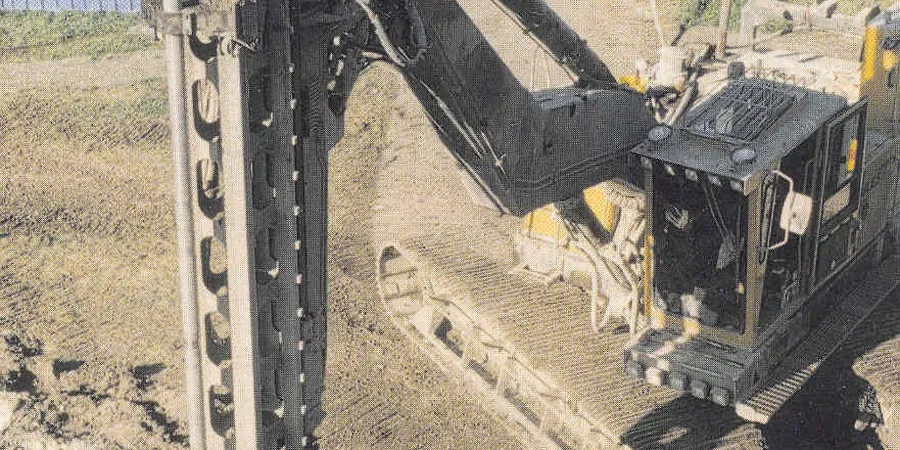
DSM design in Geelong typically requires binder dosages of 200-350 kg/m³ to treat the soft alluvial clays and compressible estuarine silts of the Barwon corridor.
Scope of work in Geelong
- Undrained shear strength (su) of target clay layers, typically 15-40 kPa in the soft zones.
- Natural moisture content exceeding 50% in the alluvial deposits, which increases binder demand.
- Presence of coarse gravel or basalt floaters that can interfere with auger penetration in the northern suburbs.
Typical technical challenges in Geelong
Geelong's rapid post-war expansion into former wetlands and the reclamation of Corio Bay's foreshore created zones of deep compressible fill that now support major infrastructure. The Geelong Ring Road and the recent duplication of the Princes Highway crossing over the Barwon River required DSM to bridge thick soft deposits beneath approach embankments. Without a correct binder mix design, failure can manifest as excessive settlement under service loads or, worse, lateral squeeze of untreated soft clay into the treated zone. The engineering team must also consider that old uncontrolled fill from the 1950s-70s often contains demolition rubble that can alter the cement hydration chemistry.
Our services
Our Geelong-based team provides the following DSM-related services, each tailored to the local ground conditions and project scale.
Binder mix design and laboratory trials
We formulate cement-slag blends and run unconfined compression tests at 7, 14, and 28 days on samples mixed with Geelong's native clays to optimise strength gain and reduce binder consumption.
Column layout and structural verification
Using a block or panel layout depending on the load path, we design column spacing and depth such that the treated ground modulus meets the project's settlement tolerance, typically under 25 mm for bridge abutments.
Field trial supervision and QA/QC
We supervise full-scale trial columns on site, measuring wet grab density, flow rate, and penetration resistance, then correlate with the lab results before production commences.
Frequently asked questions
What is the typical cost range for a deep soil mixing design in Geelong?
The fee for a deep soil mixing design package, including laboratory binder trials and column layout, usually falls between AU$2.840 and AU$9.860 depending on the number of soil units tested and whether a field trial is included. This does not cover the contractor's execution cost.
How deep can DSM columns be installed in Geelong's basalt-derived clays?
In the basaltic clay zones of Highton and Waurn Ponds, auger refusal typically occurs between 8 and 12 metres where unweathered basalt floaters or bedrock is encountered. In the softer alluvial clays of the Barwon floodplain, depths of 15-18 metres are achievable with high-torque DSM rigs.
Which Australian standard governs DSM design and testing?
AS 1726:2017 sets the framework for geotechnical site investigation, while AS 4678:2002 covers earth-retaining structures where DSM is used for in-situ stabilisation. For the binder mix itself, we follow FHWA-HRT-13-046 as a guideline, supplemented by AS 1289 for compressive strength testing of the treated soil-cement cylinders.
Can DSM reduce the risk of liquefaction in Geelong's sandy soils?
Yes, DSM can densify loose to medium-dense sands and silty sands found along the Barwon River and in parts of Corio. The treated columns act as stiff inclusions that reduce cyclic shear strains in the surrounding soil, lowering the liquefaction potential. However, a site-specific cyclic triaxial test on the treated material is recommended to confirm the design.